

Case Study 3: $200M Pipeline Revenue < 6 months
Executive Summary
When Arrivia's D2C travel platform was losing qualified leads and customers due to pricing transparency issues and checkout friction, I led a cross-functional initiative that delivered $200M in additional sales pipeline within 6 months. Rather than pursuing disruptive redesigns, I implemented a research-driven approach that identified high-impact, low-effort improvements—focusing on upfront pricing transparency, streamlined sign-up processes, and trust-building elements. By aligning UX research with existing development cycles and business priorities, we achieved a 6.1% increase in user sign-ups while establishing a repeatable framework for rapid optimization, and prioritization clarity for our 18mo roadmap that demonstrated Design's strategic value to executive leadership.
Role: Led discovery, design, led the UX Department, Key Product Channels (Product Manager) and handoff to the Sprint team as Executive Director.
Key Stakeholders: I reported requirements and progress to the CPO, CMO, CTO and CXO. Each leader had a vested interest for revenue, lead gen, implementation and sales enablement.
Timeline: 6 month project from inception to production release.
Key Problem to Solve: Transition trust from a price compare site to a shopping and converting site.
Key Tools and Skills:
- Researcher on GA4, Clarity and Crazy Egg to gather quantitative insights.
- Empathy for our members who want to use their benefits, and inspired travelers who want a good deal.
- UX collaborator with my team drafting patterns, wireframes and final deliverables.
- Project Manager to ensure we deliver on time and under budget with quality.
The Challenge
Arrivia's D2C travel platform was experiencing significant conversion friction that was directly impacting our sales pipeline. Despite driving quality traffic to our platform, we were losing potential customers at critical moments in their journey, particularly around pricing transparency and the checkout process.
Additionally, our D2C market was our pipeline for Membership, a Costco like membership program that rewarded with deep travel discounts using Points, Virtual Cash, Certificates and combinations of virtual currency.
Key Problem Areas Identified:
- Users were abandoning their shopping sessions to seek pricing information elsewhere
- Low sign-up rates prevented sales teams from capturing qualified leads
- Usability friction was creating trust issues around pricing
- The platform didn't support returning users' mental models for price comparison shopping (especially if their session timed out)
- Lack of pricing transparency was undermining user confidence
Strategic Approach
Rather than implementing large-scale redesigns that would disrupt ongoing development cycles, I led a research-driven approach focused on identifying high-impact, low-effort improvements that could be implemented quickly.
Research & Discovery Process:
- Funnel Analysis: Deep dive into user behavior data to identify specific drop-off points
- User Journey Mapping: Understanding the complete user experience from first visit to conversion
- Usability Testing: Observing actual user behavior and pain points in real-time
- Competitive Analysis: Benchmarking against industry best practices for travel e-commerce
Key Insights Discovered:
- Users expected to see final pricing upfront but were being forced to navigate to checkout first
- The lack of persistent pricing information forced users to start over each visit
- Sign-up friction was preventing sales teams from nurturing qualified leads
- Users needed confidence-building elements around pricing accuracy
Success required seamless coordination across multiple departments to ensure rapid implementation without disrupting existing roadmaps.
Stakeholder Alignment:
- Product Teams: Prioritized quick-win improvements that fit within existing sprint cycles
- Engineering: Identified technical feasibility for rapid implementation
- Sales: Validated that improved lead capture would directly impact their pipeline
- Marketing: Ensured changes aligned with broader customer acquisition strategies
Communication Strategy:
- Presented research findings with clear business impact projections
- Created implementation roadmaps that balanced quick wins with larger strategic initiatives
- Established success metrics that all teams could rally around
Design Execution
The UX team had already begun auditing inconsistent patterns across the platform, providing a foundation for rapid improvements.
We had an off-site Design Summit planned and this was the perfect problem to focus on. We needed to update our pricing block pattern across all our products, Hotel, Resort, Cruise, Air, Car, etc.
Implementation Strategy:
- Quick-Hit Improvements: Focused on changes that could be implemented within existing sprints
- Pattern Standardization: Leveraged ongoing UX audit work to ensure consistency
- Incremental Rollout: Allowed for testing and refinement without major disruption
- Future-Proofing: Ensured quick fixes aligned with longer-term design system goals
Key Design Solutions:
- Upfront pricing transparency to eliminate user uncertainty
- Streamlined sign-up process to capture leads more effectively
- Improved navigation patterns that supported returning user behavior
- Enhanced trust indicators around pricing accuracy
Figure: Sketch of a product card, that was a co-design workshop held in sunny La Jolla, CA
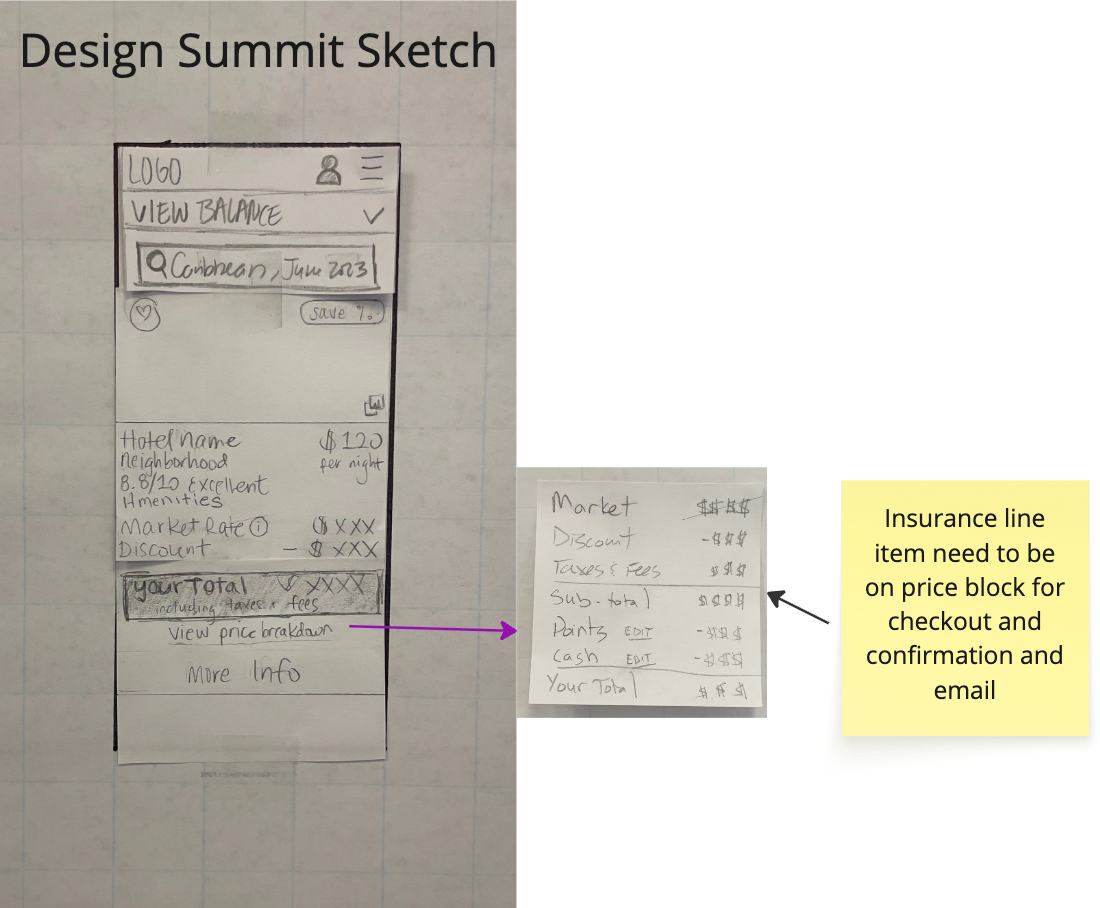
Figure: Low fidelity designs in Miro of CTA patterns and usability implication considerations with the team.
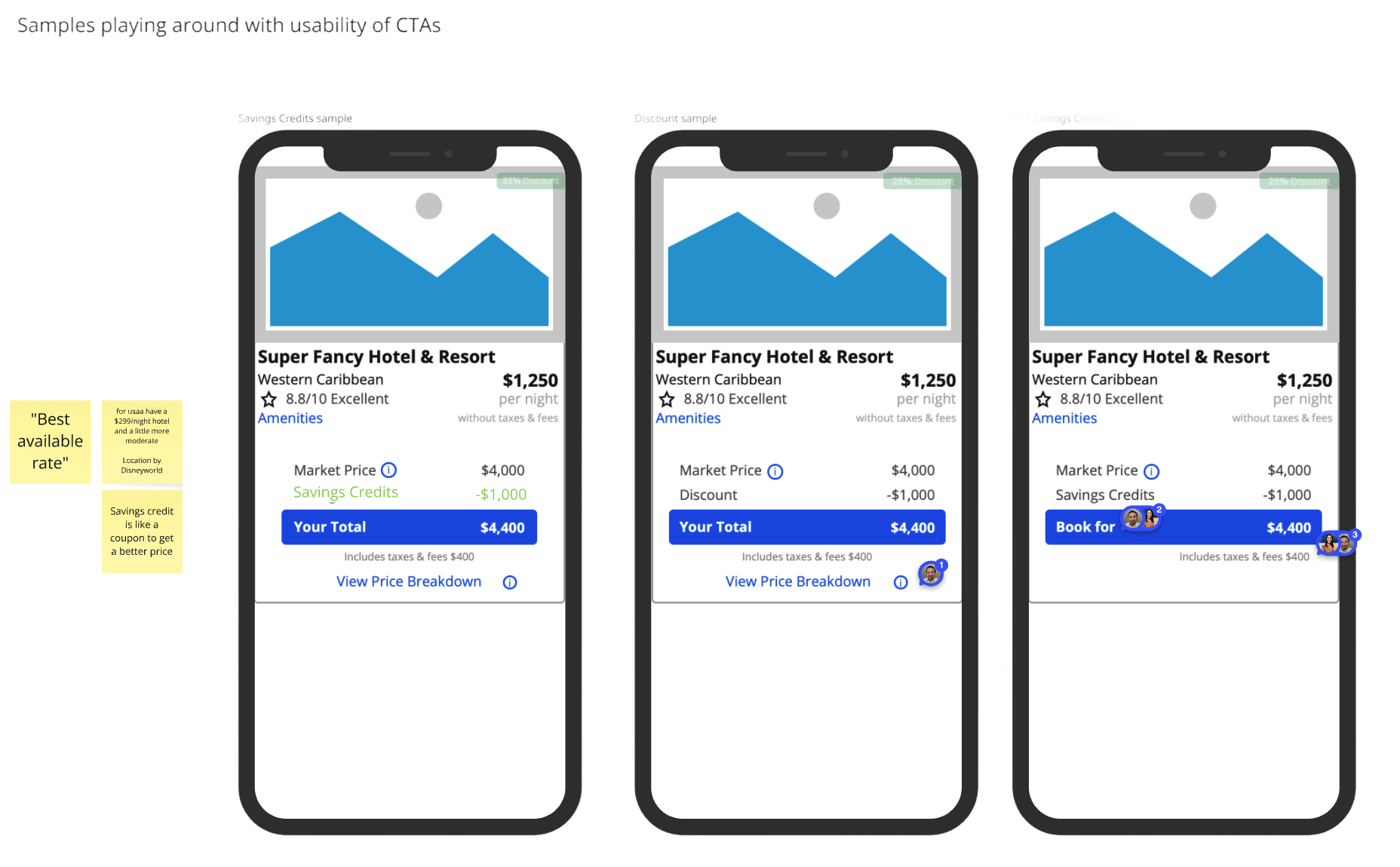
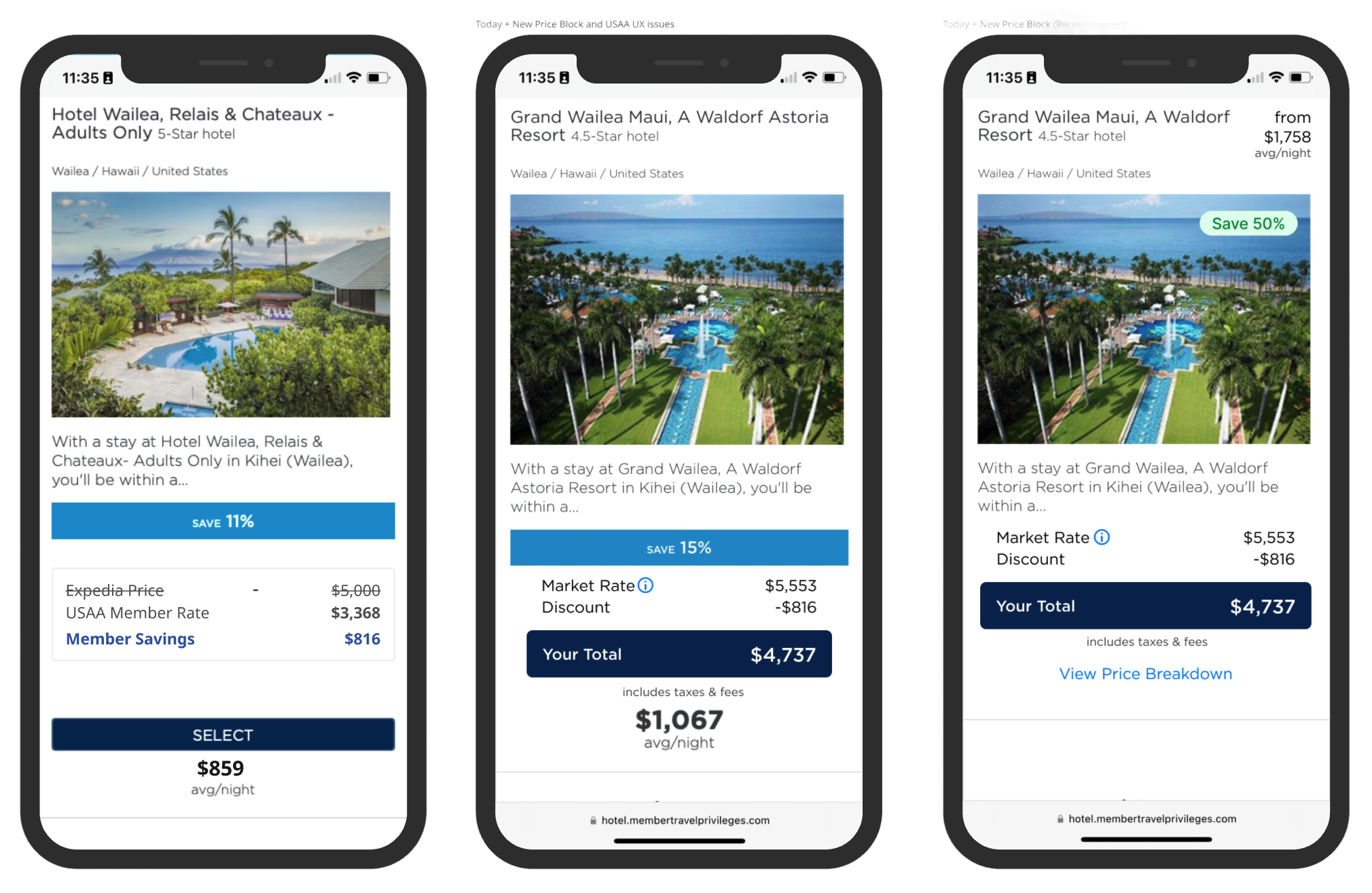
Figure: Designs in Miro of the Pricing Block to 1. highlight the membership value, 2. Build trust by showing more competitor prices in modal, 3. Full price with Taxes & Fees, 4. Simpler pricing breakdown. Left design was legacy, middle was alternate 1 and far right was the recommendation.
Measurable Impact
The results exceeded expectations and provided a clear model for future optimization efforts across all our product lines.
Within 6 Months:
- 6.1% increase in user sign-ups translated to approximately $200M in additional sales pipeline
- Reduced funnel depth with less back-and-forth navigation
- Increased daily active sessions indicating improved user engagement
- Improved conversion rates across multiple touchpoints
- Reduced user drop-off at critical decision points
Longer-Term Benefits:
- Created alignment between UX research and business metrics
- Demonstrated the value of incremental, research-driven optimization for short term and long term benefit
- Built organizational confidence in UX’s ability to drive revenue
Strategic Lessons & Applications
This project demonstrated several key principles that I've applied to subsequent leadership roles:
- Strategic Research Prioritization Quick, focused research can identify high-impact opportunities that don't require major resource allocation.
- Cross-Functional Integration Success requires aligning design improvements with existing business processes and development cycles.
- Incremental Impact Strategy Small, well-researched changes can generate significant business results when applied systematically.
- Metrics-Driven Validation Establishing clear success metrics upfront ensures stakeholder buy-in and provides clear ROI demonstration.
- Scalable Process Development Creating repeatable frameworks for optimization allows organizations to continuously improve without major disruption.
Next Steps & Future Applications
This success established a foundation for ongoing optimization efforts and demonstrated design's strategic value to executive leadership.
Immediate Follow-Up:
- Expanded research program to identify additional optimization opportunities
- Developed systematic approach for rapid UX improvements
- Created metrics dashboard for ongoing conversion monitoring
Strategic Applications:
- Framework has been applied to subsequent product launches
- Research methodology adopted across multiple product teams
- Cross-functional collaboration model replicated for other initiatives
This case study demonstrates how strategic UX leadership can drive immediate business impact while building sustainable organizational capabilities for continued growth.

Inspirations
Contact
Case Study 3: $200M Pipeline Revenue < 6 months
Executive Summary
When Arrivia's D2C travel platform was losing qualified leads and customers due to pricing transparency issues and checkout friction, I led a cross-functional initiative that delivered $200M in additional sales pipeline within 6 months. Rather than pursuing disruptive redesigns, I implemented a research-driven approach that identified high-impact, low-effort improvements—focusing on upfront pricing transparency, streamlined sign-up processes, and trust-building elements. By aligning UX research with existing development cycles and business priorities, we achieved a 6.1% increase in user sign-ups while establishing a repeatable framework for rapid optimization, and prioritization clarity for our 18mo roadmap that demonstrated Design's strategic value to executive leadership.
Role: Led discovery, design, led the UX Department, Key Product Channels (Product Manager) and handoff to the Sprint team as Executive Director.
Key Stakeholders: I reported requirements and progress to the CPO, CMO, CTO and CXO. Each leader had a vested interest for revenue, lead gen, implementation and sales enablement.
Timeline: 6 month project from inception to production release.
Key Problem to Solve: Transition trust from a price compare site to a shopping and converting site.
Key Tools and Skills:
- Researcher on GA4, Clarity and Crazy Egg to gather quantitative insights.
- Empathy for our members who want to use their benefits, and inspired travelers who want a good deal.
- UX collaborator with my team drafting patterns, wireframes and final deliverables.
- Project Manager to ensure we deliver on time and under budget with quality.
Jump to a Section:
The Challenge
Arrivia's D2C travel platform was experiencing significant conversion friction that was directly impacting our sales pipeline. Despite driving quality traffic to our platform, we were losing potential customers at critical moments in their journey, particularly around pricing transparency and the checkout process.
Additionally, our D2C market was our pipeline for Membership, a Costco like membership program that rewarded with deep travel discounts using Points, Virtual Cash, Certificates and combinations of virtual currency.
Key Problem Areas Identified:
- Users were abandoning their shopping sessions to seek pricing information elsewhere
- Low sign-up rates prevented sales teams from capturing qualified leads
- Usability friction was creating trust issues around pricing
- The platform didn't support returning users' mental models for price comparison shopping (especially if their session timed out)
- Lack of pricing transparency was undermining user confidence
Strategic Approach
Rather than implementing large-scale redesigns that would disrupt ongoing development cycles, I led a research-driven approach focused on identifying high-impact, low-effort improvements that could be implemented quickly.
Research & Discovery Process:
- Funnel Analysis: Deep dive into user behavior data to identify specific drop-off points
- User Journey Mapping: Understanding the complete user experience from first visit to conversion
- Usability Testing: Observing actual user behavior and pain points in real-time
- Competitive Analysis: Benchmarking against industry best practices for travel e-commerce
Key Insights Discovered:
- Users expected to see final pricing upfront but were being forced to navigate to checkout first
- The lack of persistent pricing information forced users to start over each visit
- Sign-up friction was preventing sales teams from nurturing qualified leads
- Users needed confidence-building elements around pricing accuracy
Cross-Functional Collaboration
Success required seamless coordination across multiple departments to ensure rapid implementation without disrupting existing roadmaps.
Stakeholder Alignment:
- Product Teams: Prioritized quick-win improvements that fit within existing sprint cycles
- Engineering: Identified technical feasibility for rapid implementation
- Sales: Validated that improved lead capture would directly impact their pipeline
- Marketing: Ensured changes aligned with broader customer acquisition strategies
Communication Strategy:
- Presented research findings with clear business impact projections
- Created implementation roadmaps that balanced quick wins with larger strategic initiatives
- Established success metrics that all teams could rally around
Design Execution
The UX team had already begun auditing inconsistent patterns across the platform, providing a foundation for rapid improvements.
We had an off-site Design Summit planned and this was the perfect problem to focus on. We needed to update our pricing block pattern across all our products, Hotel, Resort, Cruise, Air, Car, etc.
Implementation Strategy:
- Quick-Hit Improvements: Focused on changes that could be implemented within existing sprints
- Pattern Standardization: Leveraged ongoing UX audit work to ensure consistency
- Incremental Rollout: Allowed for testing and refinement without major disruption
- Future-Proofing: Ensured quick fixes aligned with longer-term design system goals
Key Design Solutions:
- Upfront pricing transparency to eliminate user uncertainty
- Streamlined sign-up process to capture leads more effectively
- Improved navigation patterns that supported returning user behavior
- Enhanced trust indicators around pricing accuracy
Figure: Sketch of a product card, that was a co-design workshop held in sunny La Jolla, CA
Figure: Low fidelity designs in Miro of CTA patterns and usability implication considerations with the team.
Figure: Designs in Miro of the Pricing Block to 1. highlight the membership value, 2. Build trust by showing more competitor prices in modal, 3. Full price with Taxes & Fees, 4. Simpler pricing breakdown. Left design was legacy, middle was alternate 1 and far right was the recommendation.
Measurable Impact
The results exceeded expectations and provided a clear model for future optimization efforts across all our product lines.
Within 6 Months:
- 6.1% increase in user sign-ups translated to approximately $200M in additional sales pipeline
- Reduced funnel depth with less back-and-forth navigation
- Increased daily active sessions indicating improved user engagement
- Improved conversion rates across multiple touchpoints
- Reduced user drop-off at critical decision points
Longer-Term Benefits:
- Created alignment between UX research and business metrics
- Demonstrated the value of incremental, research-driven optimization for short term and long term benefit
- Built organizational confidence in UX’s ability to drive revenue
Strategic Lessons & Applications
This project demonstrated several key principles that I've applied to subsequent leadership roles:
- Strategic Research Prioritization Quick, focused research can identify high-impact opportunities that don't require major resource allocation.
- Cross-Functional Integration Success requires aligning design improvements with existing business processes and development cycles.
- Incremental Impact Strategy Small, well-researched changes can generate significant business results when applied systematically.
- Metrics-Driven Validation Establishing clear success metrics upfront ensures stakeholder buy-in and provides clear ROI demonstration.
- Scalable Process Development Creating repeatable frameworks for optimization allows organizations to continuously improve without major disruption.
Next Steps & Future Applications
This success established a foundation for ongoing optimization efforts and demonstrated design's strategic value to executive leadership.
Immediate Follow-Up:
- Expanded research program to identify additional optimization opportunities
- Developed systematic approach for rapid UX improvements
- Created metrics dashboard for ongoing conversion monitoring
Strategic Applications:
- Framework has been applied to subsequent product launches
- Research methodology adopted across multiple product teams
- Cross-functional collaboration model replicated for other initiatives
This case study demonstrates how strategic UX leadership can drive immediate business impact while building sustainable organizational capabilities for continued growth.