

Case Study 2: Evolving Service Provider Applications and Service
Jump to a Section:
- Executive Summary
- The Business Challenge
- Strategic Research & Discovery
- Cross-Functional Product Strategy
- Design & Implementation
- Measurable Impact & Business Results
- Strategic Innovation & Technical Leadership
- Future Applications & Continued Impact
- Key Leadership Lessons
Executive Summary
At Vixxo, an integrated facilities management company serving Fortune 500 retail and convenience clients, I led the transformation of a critical service management platform that served Mid-Market to Enterprise Companies, Service Provider and Trade Specialists, and our Investors. The platform supporting Starbucks' specialized espresso machine maintenance was a significant portion of transactions and revenue. Through ethnographic research and mobile-first redesign, we enabled technicians to complete 5 service visits per shift versus 4, generating $2M-$10M in monthly revenue impact while reducing invoice disputes by 40%.
Strategic Context: When an espresso machine fail (some stores have 2 or 3, depending on drive thru vs. walk in traffic), Starbucks stores lose 30-50% of revenue. Our platform directly impacts store profitability by optimizing technician efficiency across electrical, plumbing, HVAC, and specialized coffee equipment maintenance.
The Business Challenge
Critical Problems Identified:
- Technician Efficiency Bottleneck: Service visits averaged 4 per shift with target of 5 visits
- Revenue Impact: Each downed espresso machine reduces store revenue by 30-50%
- Documentation Friction: Manual processes for audit creating invoice disputes and billing delays
- Field Connectivity Issues: Poor app performance with limited OTA networks in retail locations
- Knowledge Transfer Gaps: Technician expertise not systematically captured or shared for future prevention
- Legacy Platform: Aging platform with multiple performance bottlenecks and mobile usability challenges
- Inherited Technical Debt: Incomplete platform from previous contracted agency requiring strategic pivot
Business Stakes: For Starbucks specifically, optimizing service efficiency directly correlates to store profitability, making platform performance a critical business driver rather than just operational improvement.
Figure: Understanding the platform.
A strong UX strategy will understand the foundational elements such as Database and Architecture. Here we were investigating the System of Record (the truth), so we could look consider supporting and innovative products and features.
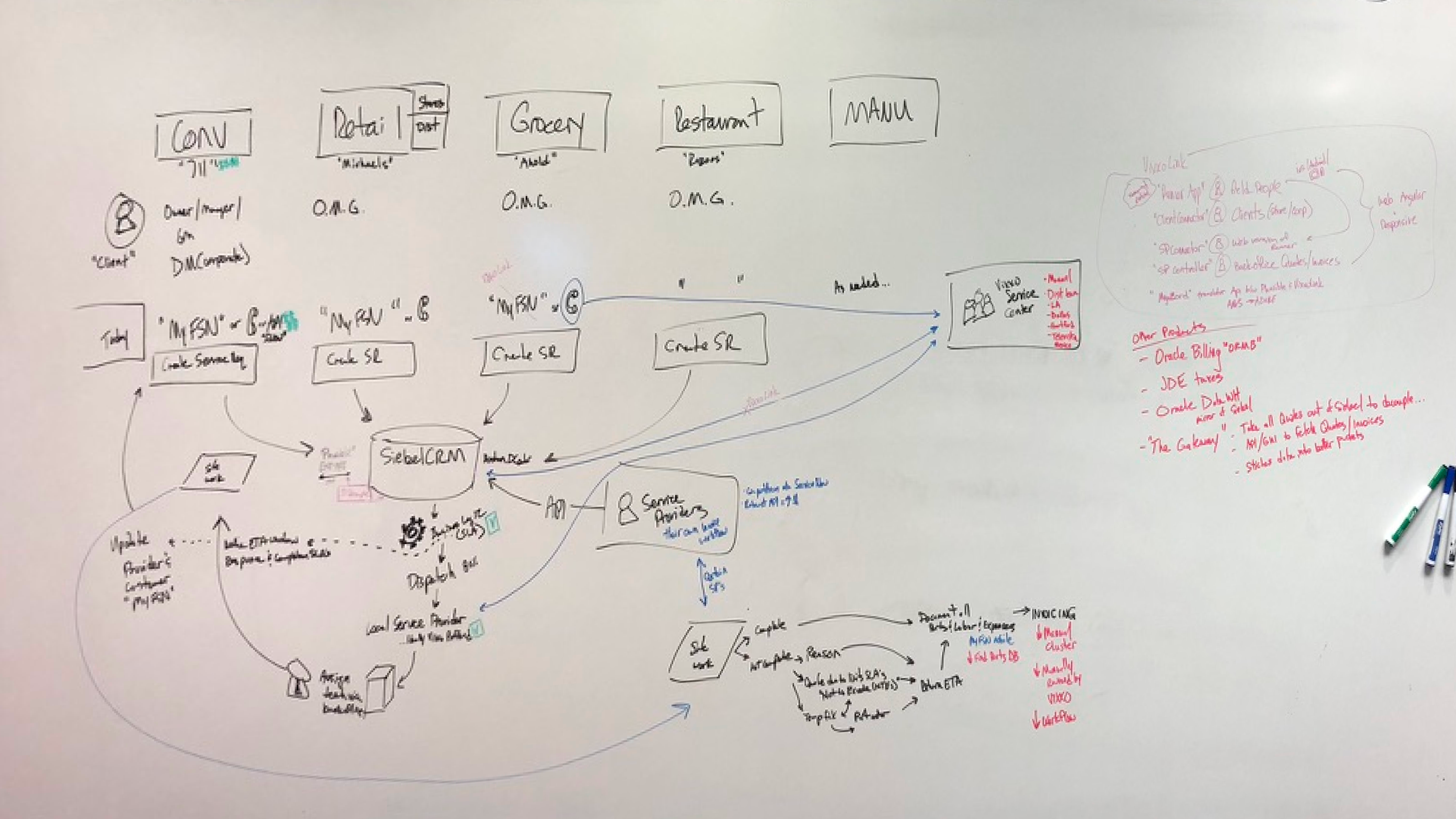
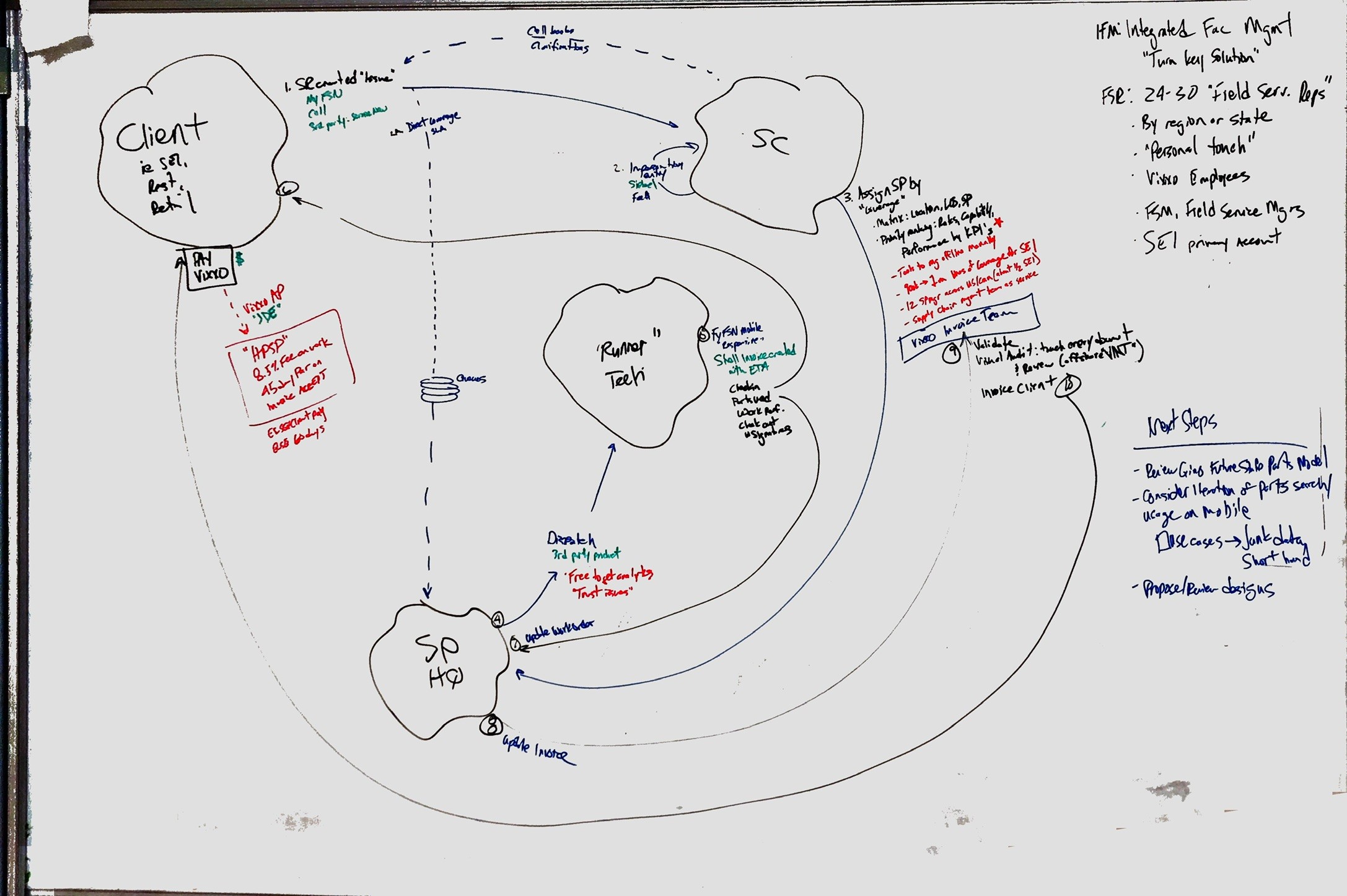
Figure: Understanding the current business ecosystem.
We have multiple distinct personas to solve for:
- Client Program Administrator
- Client Program Accounting (AP/Controller)
- Client Store Manager or Clerk
- Service Provider Program Administrator
- Service Provider Dispatcher
- Service Provider Technicians
- Service Provider Accountant
- Vixxo Dispatch
- Vixxo Customer Service (Service Center)
- Vixxo AR/AP/Controller/Accounting
- Vixxo Service Provider Account Managers
Here we were distilling the archetypes and how the “happy path” workflow from a Service Request (SR) goes through each step.
Strategic Research & Discovery
Ethnographic Field Research Approach:
- Ride-Along Methodology: Embedded research with technicians across Arizona and Southern California Starbucks locations
- Environmental Factor Analysis: Documented real-world conditions impacting technician performance
- Interaction Mapping: Systematic observation of technician workflows and friction points
- Opportunity Identification: Revenue-generating improvements beyond core service requirements
Critical Insights Discovered:
1. Knowledge Reinforcement Opportunity
- Finding: Driving time between locations (significant portion of shift) represented untapped learning opportunity
- Solution: Audio-based machine maintenance history playback (podcast-style) during transit
- Impact: Continuous technician education without reducing service time
2. Predictive Maintenance Intelligence
- Finding: Machine failure patterns correlate with shot count, regional humidity, and usage patterns
- Solution: Smart part suggestions based on failure pattern recognition across millions of parts in database
- Impact: Proactive maintenance reducing emergency service calls
3. Field Performance Optimization
- Finding: Part search performance degraded severely with limited OTA networks
- Solution: Local app storage for common parts and offline-first architecture
- Impact: Maintained productivity regardless of connectivity conditions
4. Accessibility & Data Integrity Gaps
- Finding: Field conditions required better accessibility support and graceful online/offline transitions
- Solution: Enhanced text sizing, voice input options, and vector math-based location services
- Impact: Reduced data entry errors and improved technician experience
Figure: Espresso Machine in Distress, somewhere in SoCal...
The business workflow is complex, and troubleshooting is never direct. This was a unique one. This espresso machine was not pushing proper shots. The IoT data was showing improper temperature, chamber pressure, puck size and output.
Opening the used puck drawer under the water tray, you can see one of the 2 chambers willed with water. See next figure.
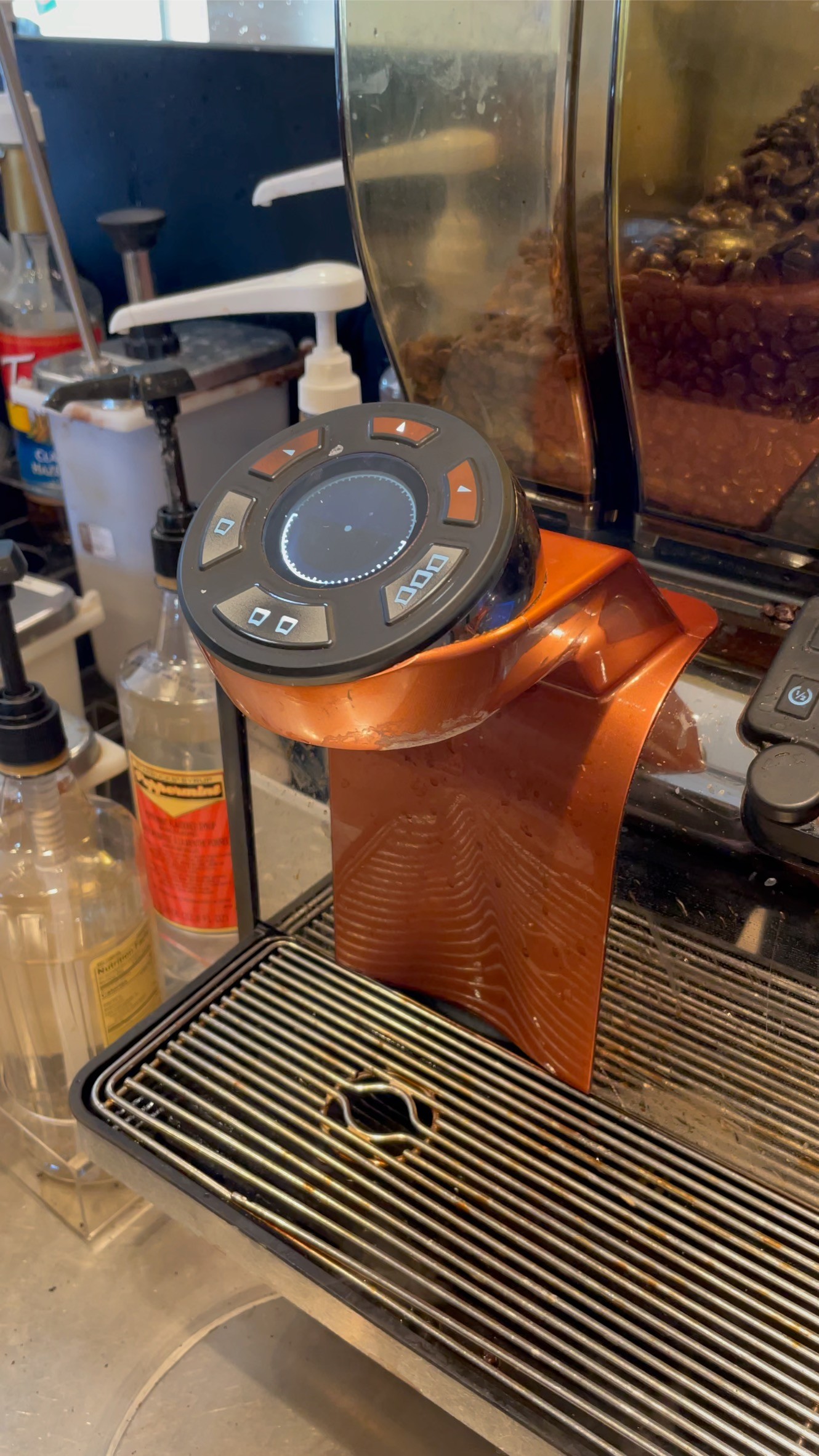
Figure: Coffee soup anyone?
These intricate espresso machines have 3 hoppers (bean types), 2 brew chambers (high compression that extracts the coffee) and 2 discard buckets, in one tray.
Here you can see Chamber A is not ejecting clean pucks, like Chamber B. The water lines are reporting clean flow (IoT telematics) but water pressure was higher than baseline.
Taking apart the machine, and pulling out the chamber A brew system and grinder, the problem started to show that there was extra fragrant oil in the grinder and into the brew chamber.
The real issue, was that the flavored syrups weren’t supposed to be next to the machines. The Baristas, who work hard, hit those syrups pumps and at times, that syrup flies around. What does sugar do at high temp, it hardens and crystalizes. So that syrup hit the hopper and worked it’s way down into the grinder and brew chamber.
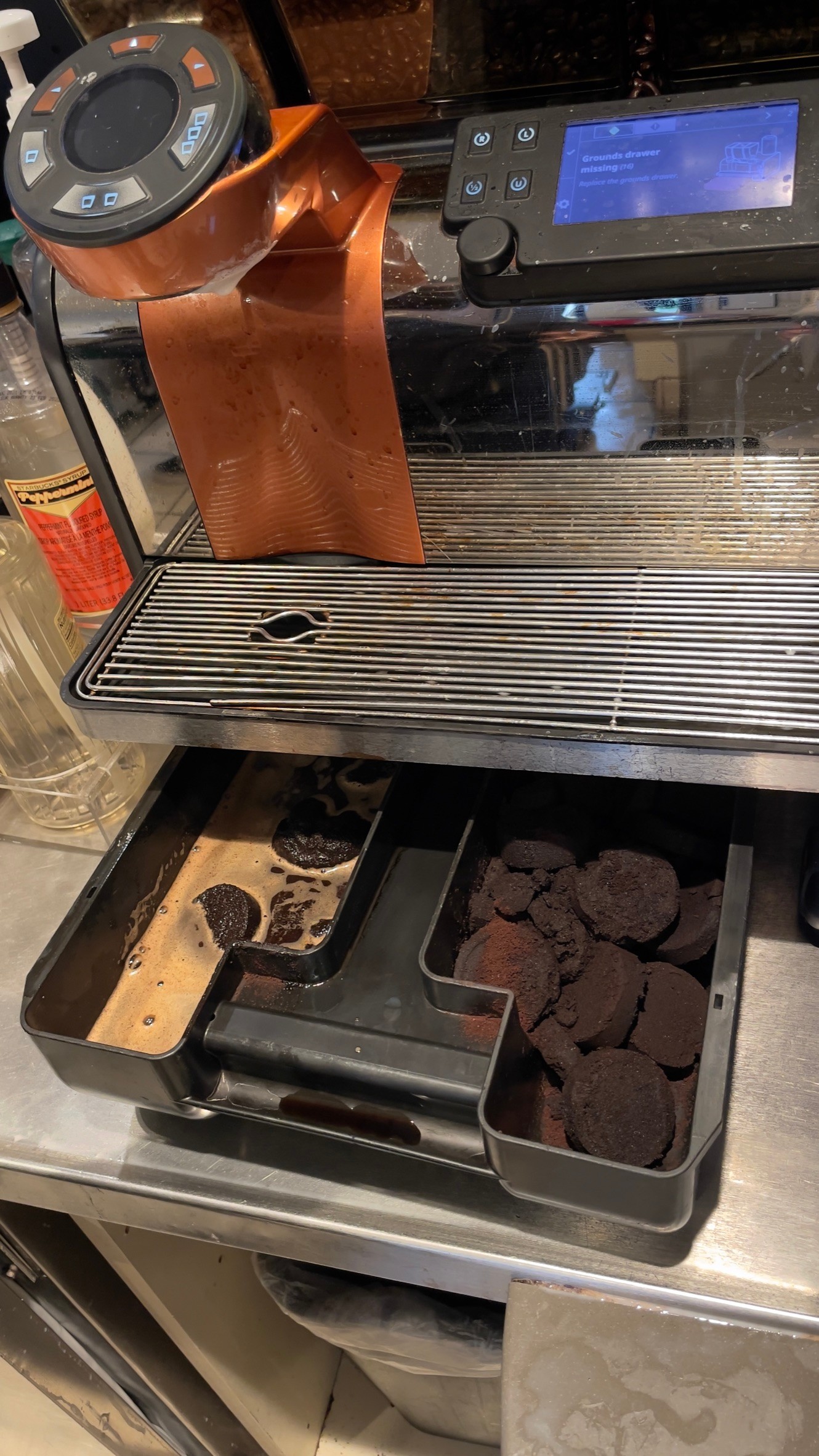
Figure: Old System, Old Workflows
We sent out a survey to all our technicians that serviced Starbucks and after analysis all the qualitative and quantitative data themes emerged. The number 1 issue was that the legacy system didn’t have a code to support the issues, usually more than one.
We did not have a root cause that called for Vanilla Syrup in the brew group. Technically this wasn’t abuse of the machine, it was a training opportunity for store configuration or having a divider to ensure there’s no cross contamination.
This machine was down for about 1 hour during morning rush, not to mention the parts and labor costs, which easily can be prevented.
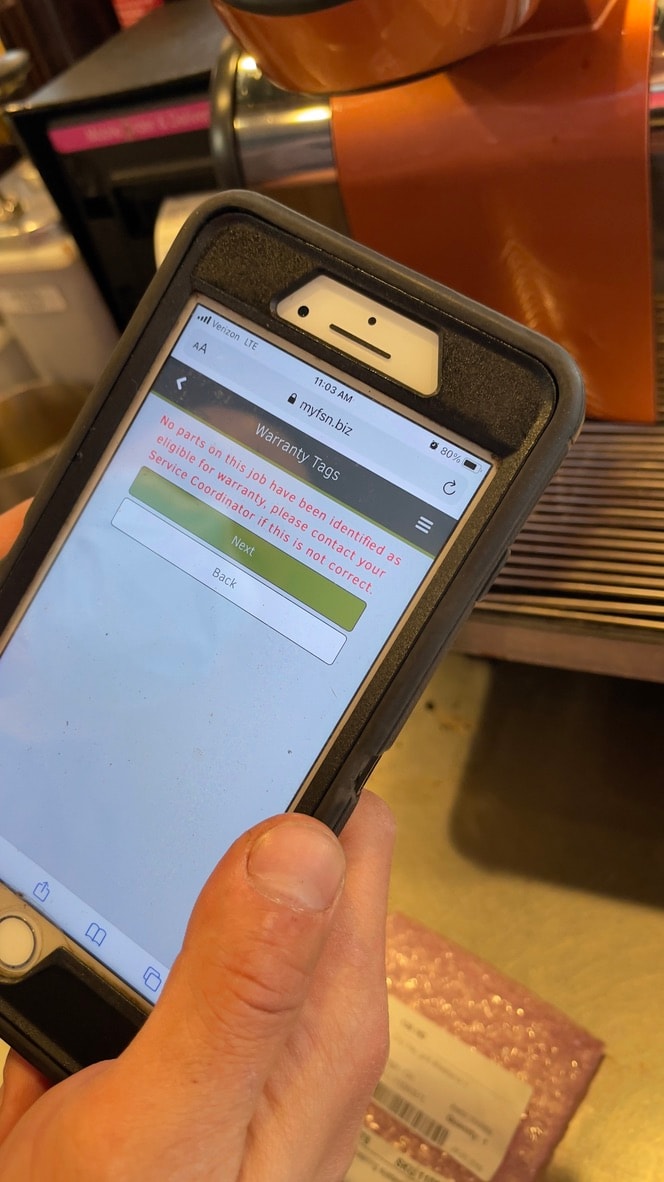
Here you can see the legacy system needing an entire page just to communicate warranty status in a webpage.
Cross-Functional Product Strategy
Technical Architecture Decisions:
- Platform Choice: Microsoft Xamarin/MAUI for single codebase supporting iOS and Android
- Offline-First Design: Vector math and local storage ensuring functionality with poor connectivity
- Real-Time Analytics: Data transparency providing insights to both Vixxo and Starbucks operations
- Legacy System Integration: API development connecting new mobile platform with existing enterprise systems
MVP Acceleration Strategy:
- Roadmap Adjustment: Pivoted from inherited incomplete platform to accelerated MVP focusing on critical friction points
- Field Learning Priority: Emphasized rapid deployment for real-world validation over feature completeness
- Iterative Improvement: Established feedback loops with technician users for continuous optimization
Design & Implementation Excellence
Mobile-First User Experience:
- Technician-Centered Design: Interface optimized for field conditions, gloves, varying lighting
- Documentation Streamlining: Photo capture, note-taking, and issue tracking integrated seamlessly
- Search Performance: Local part database with predictive suggestions reducing lookup time
- Accessibility Integration: Voice input, text sizing, and simplified navigation for diverse user needs
Technical Innovation:
- Offline Mode Intelligence: Check-in/check-out functionality using vector math and device telematics
- Graceful Error Handling: Seamless online/offline transitions maintaining data integrity
- Audio Learning System: Machine history playback during driving time maximizing knowledge transfer
- Predictive Analytics: Failure pattern recognition suggesting optimal parts and maintenance schedules
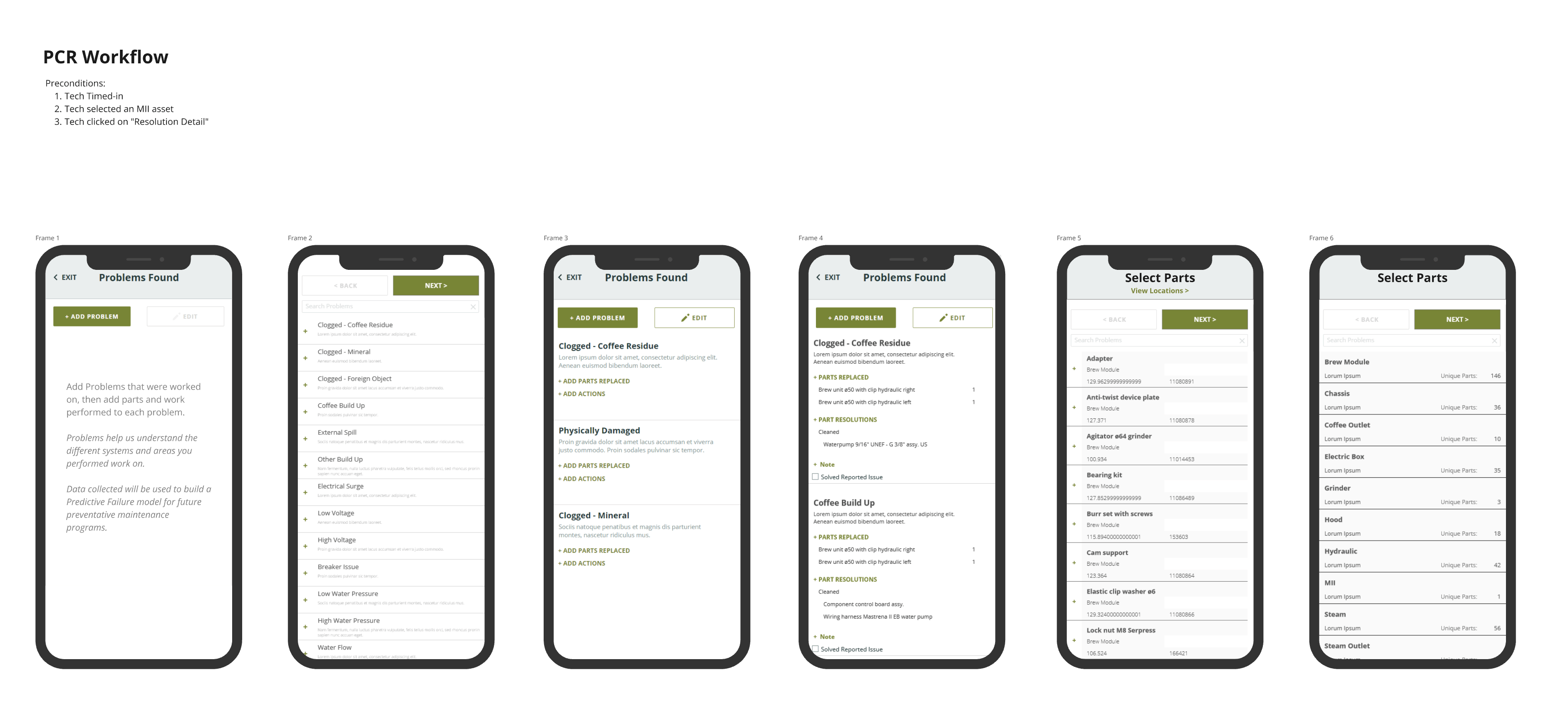
Figure: Wireframes for the supporting Multiple Problems
Measurable Impact & Business Results
Primary Revenue Impact:
- Service Efficiency Gain: Enabled +1 daily service visit per technician (5 vs. 4 visits per shift)
- Revenue Protection: Reduced machine downtime protecting 30-50% store revenue per incident
- Monthly Impact: $2M-$10M revenue protection/generation through improved service efficiency
Operational Excellence:
- 40% Invoice Error Reduction: Streamlined documentation and real-time sync minimizing billing disputes
- Improved Technician Productivity: Faster part identification and issue resolution
- Enhanced Data Transparency: Real-time analytics providing operational insights to both Vixxo and Starbucks
- Cross-Platform Efficiency: Single development effort supporting both iOS and Android deployment
Strategic Organizational Benefits:
- Scalable Platform Foundation: Architecture supporting multiple trade specialties beyond coffee equipment
- Knowledge Capture System: Systematic collection and distribution of technician expertise
- Field Research Methodology: Repeatable ethnographic approach for future platform improvements
- Client Relationship Enhancement: Demonstrated innovation improving Starbucks partnership value
Strategic Innovation & Technical Leadership
Ethnographic Research Integration: The ride-along methodology established a new standard for understanding field operations, revealing optimization opportunities that desktop-based analysis would never uncover. This human-centered approach became a template for future platform improvements across multiple trade specialties.
Predictive Intelligence Implementation: By connecting machine failure patterns with environmental factors and usage data, we transformed reactive service into proactive maintenance, creating competitive advantages for both Vixxo and client partners.
Offline-First Architecture: The vector math and local storage approach solved a critical field operations challenge, ensuring productivity regardless of connectivity limitations—a breakthrough for retail environment service platforms.
Future Applications & Continued Impact
Scalable Framework Development: The platform architecture and research methodology established foundations for expanding across Vixxo's diverse service portfolio including electrical, plumbing, HVAC, water systems, doors, and concrete maintenance.
Client Partnership Enhancement: Success with Starbucks demonstrated Vixxo's innovation capabilities, strengthening existing partnerships while creating competitive advantages for new client acquisition.
Industry Benchmark Setting: The combination of ethnographic research, mobile-first design, and predictive analytics created a new standard for field service platforms in retail and convenience sectors.
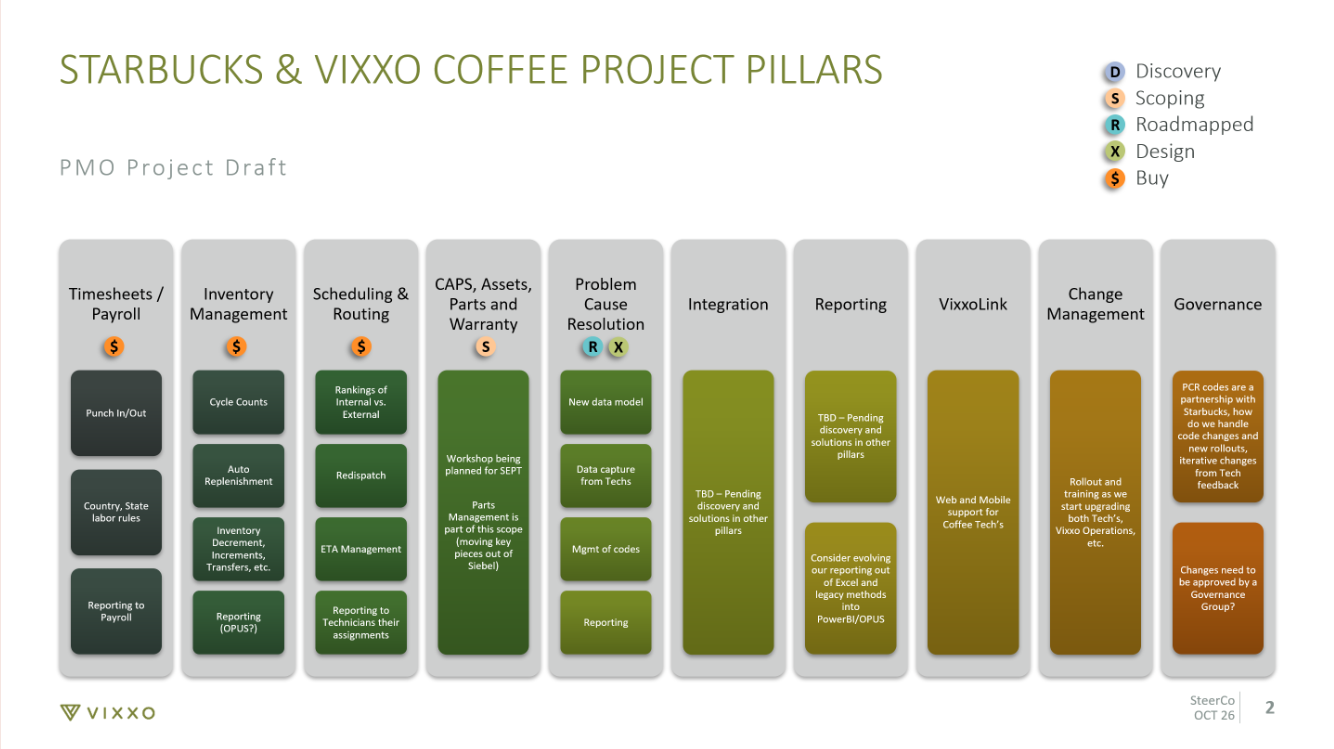
Figure: Expanding the Ecosystem with Buy / Build
Key Leadership Lessons
- Field Research Drives Innovation Ethnographic research revealed optimization opportunities that requirements gathering alone could never uncover, particularly the driving-time knowledge reinforcement insight.
- Technical Constraints Spark Creative Solutions Limited connectivity challenges led to breakthrough offline-first architecture that became a competitive advantage rather than a compromise.
- Revenue-Focused Design Thinking Understanding the direct connection between service efficiency and store profitability shaped every design decision, ensuring business impact alignment.
- Cross-Functional Technical Leadership Successfully coordinating mobile development, enterprise integration, and field operations required systematic communication and stakeholder alignment across diverse technical and business domains.

Inspirations
Contact
Case Study 2: Evolving Service Provider Applications and Service
Jump to a Section:
- Executive Summary
- The Business Challenge
- Strategic Research & Discovery
- Cross-Functional Product Strategy
- Design & Implementation
- Measurable Impact & Business Results
- Strategic Innovation & Technical Leadership
- Future Applications & Continued Impact
- Key Leadership Lessons
Executive Summary
At Vixxo, an integrated facilities management company serving Fortune 500 retail and convenience clients, I led the transformation of a critical service management platform that served Mid-Market to Enterprise Companies, Service Provider and Trade Specialists, and our Investors. The platform supporting Starbucks' specialized espresso machine maintenance was a significant portion of transactions and revenue. Through ethnographic research and mobile-first redesign, we enabled technicians to complete 5 service visits per shift versus 4, generating $2M-$10M in monthly revenue impact while reducing invoice disputes by 40%.
Strategic Context: When an espresso machine fail (some stores have 2 or 3, depending on drive thru vs. walk in traffic), Starbucks stores lose 30-50% of revenue. Our platform directly impacts store profitability by optimizing technician efficiency across electrical, plumbing, HVAC, and specialized coffee equipment maintenance.
The Business Challenge
Critical Problems Identified:
- Technician Efficiency Bottleneck: Service visits averaged 4 per shift with target of 5 visits
- Revenue Impact: Each downed espresso machine reduces store revenue by 30-50%
- Documentation Friction: Manual processes for audit creating invoice disputes and billing delays
- Field Connectivity Issues: Poor app performance with limited OTA networks in retail locations
- Knowledge Transfer Gaps: Technician expertise not systematically captured or shared for future prevention
- Legacy Platform: Aging platform with multiple performance bottlenecks and mobile usability challenges
- Inherited Technical Debt: Incomplete platform from previous contracted agency requiring strategic pivot
Business Stakes: For Starbucks specifically, optimizing service efficiency directly correlates to store profitability, making platform performance a critical business driver rather than just operational improvement.
Figure: Understanding the platform.
A strong UX strategy will understand the foundational elements such as Database and Architecture. Here we were investigating the System of Record (the truth), so we could look consider supporting and innovative products and features.
Figure: Understanding the current business ecosystem.
We have multiple distinct personas to solve for:
- Client Program Administrator
- Client Program Accounting (AP/Controller)
- Client Store Manager or Clerk
- Service Provider Program Administrator
- Service Provider Dispatcher
- Service Provider Technicians
- Service Provider Accountant
- Vixxo Dispatch
- Vixxo Customer Service (Service Center)
- Vixxo AR/AP/Controller/Accounting
- Vixxo Service Provider Account Managers
Here we were distilling the archetypes and how the “happy path” workflow from a Service Request (SR) goes through each step.
Strategic Research & Discovery
Ethnographic Field Research Approach:
- Ride-Along Methodology: Embedded research with technicians across Arizona and Southern California Starbucks locations
- Environmental Factor Analysis: Documented real-world conditions impacting technician performance
- Interaction Mapping: Systematic observation of technician workflows and friction points
- Opportunity Identification: Revenue-generating improvements beyond core service requirements
Critical Insights Discovered:
1. Knowledge Reinforcement Opportunity
- Finding: Driving time between locations (significant portion of shift) represented untapped learning opportunity
- Solution: Audio-based machine maintenance history playback (podcast-style) during transit
- Impact: Continuous technician education without reducing service time
2. Predictive Maintenance Intelligence
- Finding: Machine failure patterns correlate with shot count, regional humidity, and usage patterns
- Solution: Smart part suggestions based on failure pattern recognition across millions of parts in database
- Impact: Proactive maintenance reducing emergency service calls
3. Field Performance Optimization
- Finding: Part search performance degraded severely with limited OTA networks
- Solution: Local app storage for common parts and offline-first architecture
- Impact: Maintained productivity regardless of connectivity conditions
4. Accessibility & Data Integrity Gaps
- Finding: Field conditions required better accessibility support and graceful online/offline transitions
- Solution: Enhanced text sizing, voice input options, and vector math-based location services
- Impact: Reduced data entry errors and improved technician experience
Figure: Espresso Machine in Distress, somewhere in SoCal...
The business workflow is complex, and troubleshooting is never direct. This was a unique one. This espresso machine was not pushing proper shots. The IoT data was showing improper temperature, chamber pressure, puck size and output.
Opening the used puck drawer under the water tray, you can see one of the 2 chambers willed with water. See next figure.
Figure: Coffee soup anyone?
These intricate espresso machines have 3 hoppers (bean types), 2 brew chambers (high compression that extracts the coffee) and 2 discard buckets, in one tray.
Here you can see Chamber A is not ejecting clean pucks, like Chamber B. The water lines are reporting clean flow (IoT telematics) but water pressure was higher than baseline.
Taking apart the machine, and pulling out the chamber A brew system and grinder, the problem started to show that there was extra fragrant oil in the grinder and into the brew chamber.
The real issue, was that the flavored syrups weren’t supposed to be next to the machines. The Baristas, who work hard, hit those syrups pumps and at times, that syrup flies around. What does sugar do at high temp, it hardens and crystalizes. So that syrup hit the hopper and worked it’s way down into the grinder and brew chamber.
Figure: Old System, Old Workflows
We sent out a survey to all our technicians that serviced Starbucks and after analysis all the qualitative and quantitative data themes emerged. The number 1 issue was that the legacy system didn’t have a code to support the issues, usually more than one.
We did not have a root cause that called for Vanilla Syrup in the brew group. Technically this wasn’t abuse of the machine, it was a training opportunity for store configuration or having a divider to ensure there’s no cross contamination.
This machine was down for about 1 hour during morning rush, not to mention the parts and labor costs, which easily can be prevented.
Here you can see the legacy system needing an entire page just to communicate warranty status in a webpage.
Cross-Functional Product Strategy
Technical Architecture Decisions:
- Platform Choice: Microsoft Xamarin/MAUI for single codebase supporting iOS and Android
- Offline-First Design: Vector math and local storage ensuring functionality with poor connectivity
- Real-Time Analytics: Data transparency providing insights to both Vixxo and Starbucks operations
- Legacy System Integration: API development connecting new mobile platform with existing enterprise systems
MVP Acceleration Strategy:
- Roadmap Adjustment: Pivoted from inherited incomplete platform to accelerated MVP focusing on critical friction points
- Field Learning Priority: Emphasized rapid deployment for real-world validation over feature completeness
- Iterative Improvement: Established feedback loops with technician users for continuous optimization
Design & Implementation Excellence
Mobile-First User Experience:
- Technician-Centered Design: Interface optimized for field conditions, gloves, varying lighting
- Documentation Streamlining: Photo capture, note-taking, and issue tracking integrated seamlessly
- Search Performance: Local part database with predictive suggestions reducing lookup time
- Accessibility Integration: Voice input, text sizing, and simplified navigation for diverse user needs
Technical Innovation:
- Offline Mode Intelligence: Check-in/check-out functionality using vector math and device telematics
- Graceful Error Handling: Seamless online/offline transitions maintaining data integrity
- Audio Learning System: Machine history playback during driving time maximizing knowledge transfer
- Predictive Analytics: Failure pattern recognition suggesting optimal parts and maintenance schedules
Figure: Wireframes for the supporting Multiple Problems
Measurable Impact & Business Results
Primary Revenue Impact:
- Service Efficiency Gain: Enabled +1 daily service visit per technician (5 vs. 4 visits per shift)
- Revenue Protection: Reduced machine downtime protecting 30-50% store revenue per incident
- Monthly Impact: $2M-$10M revenue protection/generation through improved service efficiency
Operational Excellence:
- 40% Invoice Error Reduction: Streamlined documentation and real-time sync minimizing billing disputes
- Improved Technician Productivity: Faster part identification and issue resolution
- Enhanced Data Transparency: Real-time analytics providing operational insights to both Vixxo and Starbucks
- Cross-Platform Efficiency: Single development effort supporting both iOS and Android deployment
Strategic Organizational Benefits:
- Scalable Platform Foundation: Architecture supporting multiple trade specialties beyond coffee equipment
- Knowledge Capture System: Systematic collection and distribution of technician expertise
- Field Research Methodology: Repeatable ethnographic approach for future platform improvements
- Client Relationship Enhancement: Demonstrated innovation improving Starbucks partnership value
Strategic Innovation & Technical Leadership
Ethnographic Research Integration: The ride-along methodology established a new standard for understanding field operations, revealing optimization opportunities that desktop-based analysis would never uncover. This human-centered approach became a template for future platform improvements across multiple trade specialties.
Predictive Intelligence Implementation: By connecting machine failure patterns with environmental factors and usage data, we transformed reactive service into proactive maintenance, creating competitive advantages for both Vixxo and client partners.
Offline-First Architecture: The vector math and local storage approach solved a critical field operations challenge, ensuring productivity regardless of connectivity limitations—a breakthrough for retail environment service platforms.
Future Applications & Continued Impact
Scalable Framework Development: The platform architecture and research methodology established foundations for expanding across Vixxo's diverse service portfolio including electrical, plumbing, HVAC, water systems, doors, and concrete maintenance.
Client Partnership Enhancement: Success with Starbucks demonstrated Vixxo's innovation capabilities, strengthening existing partnerships while creating competitive advantages for new client acquisition.
Industry Benchmark Setting: The combination of ethnographic research, mobile-first design, and predictive analytics created a new standard for field service platforms in retail and convenience sectors.
Figure: Expanding the Ecosystem with Buy / Build
Key Leadership Lessons
- Field Research Drives Innovation Ethnographic research revealed optimization opportunities that requirements gathering alone could never uncover, particularly the driving-time knowledge reinforcement insight.
- Technical Constraints Spark Creative Solutions Limited connectivity challenges led to breakthrough offline-first architecture that became a competitive advantage rather than a compromise.
- Revenue-Focused Design Thinking Understanding the direct connection between service efficiency and store profitability shaped every design decision, ensuring business impact alignment.
- Cross-Functional Technical Leadership Successfully coordinating mobile development, enterprise integration, and field operations required systematic communication and stakeholder alignment across diverse technical and business domains.